Bathroom Drawer Organization That Survives a Busy Morning
Last updated: 2026-07-03 · 4 min read
The bathroom drawer is where good intentions go to die. You start with everything in its place, and six weeks later you are raking through a pile of expired lip balm, a mystery hair tie, and three nearly identical nail clippers just to find your concealer. The drawer did not fail you. The system did, because there was no system. A drawer that survives a busy morning is not about being a neat freak. It is about removing decisions from a time of day when you have zero bandwidth to make them. Here is how to build one that actually holds up.
Start by Pulling Everything Out
Do not organize around what is already in there. Take every single item out and put it on the counter. This is the only way to see what you actually have versus what has just been riding along, taking up space.
As you sort, make three piles: keep, relocate, and toss. Toss anything expired, anything with a broken cap, and anything you have not touched in three months. Relocate things that belong in a different room entirely (yes, the random pen goes back to the desk). Only what is left goes back in.
Measure Before You Buy Anything
This step saves you from the most common drawer organization mistake: buying inserts that do not fit. Measure your drawer interior, length, width, and depth, and write it down before you open a single product page.
Most bathroom drawers fall between 18 and 24 inches wide and 14 to 18 inches deep. Depth matters more than people realize. A 2-inch-deep insert in a 3-inch drawer leaves a full inch of dead space above every item, which means things slide around and tips over. Aim for inserts that come within a half inch of your drawer depth.
Divide Into Zones, Not Categories
The goal is not to sort by product type. It is to sort by when and how you reach for things. Think in terms of daily use, weekly use, and occasional use.
Daily items, your toothbrush, face wash, and whatever you put on every morning without fail, belong front and center. Weekly items like a spare razor or nail file go toward the back. Occasional items, the stuff you only grab before a special event or trip, belong in a separate drawer if possible, or at the very back behind a clear divider.
This zone approach is what makes a drawer feel effortless at 7 a.m. You are not searching. You are just reaching.
Use Inserts That Stay Put
Loose inserts shift every time you open the drawer, and within a week your zones have merged back into chaos. The fix is either non-slip liner under your inserts, or inserts that fit snugly enough that they cannot travel.
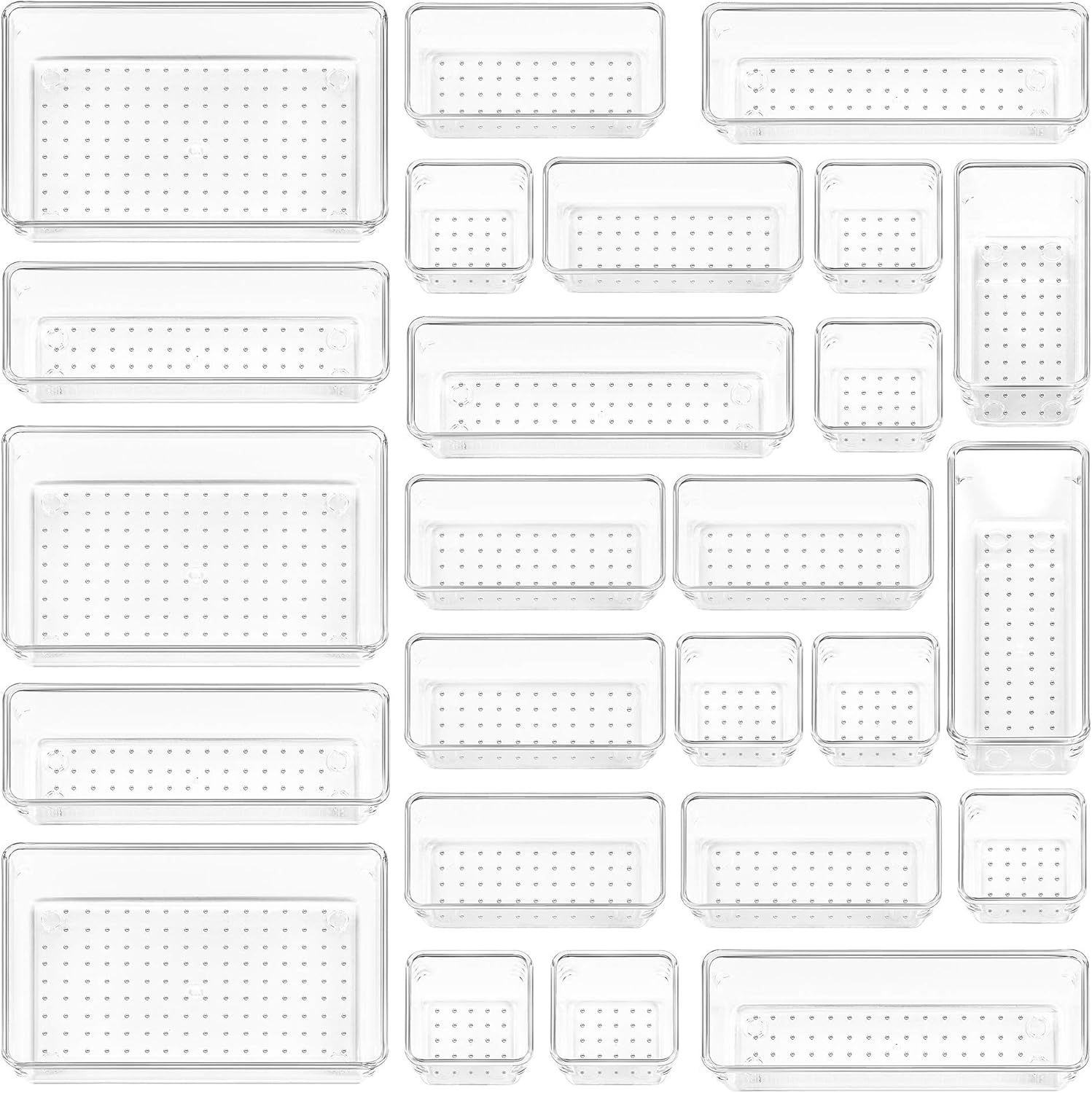
For most bathroom drawers, a set of clear sectioned inserts works better than bamboo grids because you can actually see what is inside each compartment without picking it up. Clear Plastic Drawer Organizers (25-Piece Set) A 25-piece set of clear plastic organizers gives you enough pieces to customize the layout to your exact items, not a one-size-fits-all approximation.
If you prefer a warmer look (my fiance has opinions about too much plastic, and those opinions are loud), Bamboo Expandable Drawer Organizer a bamboo expandable drawer organizer can stretch to fit a range of drawer widths and holds its position well.
Handle the Awkward Items Separately
Some things just do not fit neatly in a standard insert. Cotton balls pile up and take over a compartment. Q-tips need a container with a lid so they stay clean. Hair ties become a tangled knot unless contained.
Small lidded containers are your best friend here. Glass Apothecary Storage Jars (6-Set) Glass apothecary jars with lids keep cotton balls and q-tips contained, visible, and genuinely nice to look at. Put them in the back section of your drawer or on the counter if you have the surface space. If they live in the drawer, make sure they are short enough that the drawer closes fully.
Label Everything (Yes, Really)
I know, I know. But hear me out. Labels are not about being rigid. They are about making it easy for the system to recover after a disrupted week or a guest who means well but puts things back in the wrong spot.
You do not need to label every single compartment. Label the sections that are most likely to drift: daily versus weekly, or by person if you share the drawer. Even a small piece of tape with handwriting works. The label is a reset button. It tells you exactly where things go when you are tired and just want to shove everything back in before bed.
Maintain It With a Two-Minute Weekly Reset
The best drawer organization falls apart without a small maintenance habit. Once a week, usually right after a shower when you are already standing there, spend two minutes putting anything that has drifted back in its zone. Toss any empty packaging. That is it.
If your weekly reset is consistently taking longer than that, the system needs adjusting, not more discipline. Either a zone is too small, or something you are using daily is assigned to the wrong section. Tweak it. A good system should feel almost automatic after a few weeks.
The takeaway: A bathroom drawer that works on a busy morning is built on three things: only keeping what belongs there, dividing by when you use it rather than what it is, and using inserts that do not move. Get those three right and you stop losing time to a drawer every single morning. Small investment, genuinely unreasonable return.


